

The HW Method

The HW Method

HW wall drying - installation

The HW Method in Recognized Technical Standards

HW wall drying - installation
Regulatory Frameworks

Described in accordance with recognized technical standards

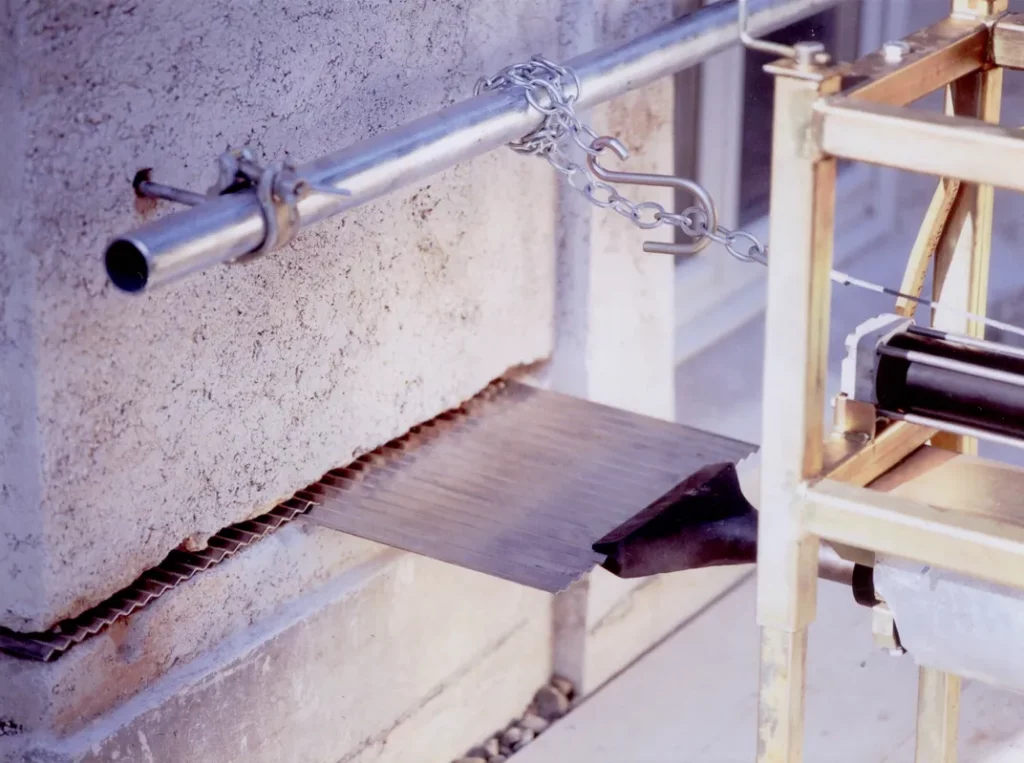
The HW stainless steel sheet method corresponds to the single-stage mechanical method described in Section 8.2 of ÖNORM B 3355:2017. In this process, the final barrier layer, consisting of corrugated metal sheets, is installed into a continuous horizontal bed joint in the masonry using vibration.

In Germany, WTA Technical Note 4-7, „Retrofit Mechanical Horizontal Water Barriers,“ addresses the sheet metal driving method as a mechanical technique and specifies stainless steel plates as the barrier material to be used.

ÖNORM B 3355:2017

This Austrian standard addresses the dewatering of damp masonry, covering everything from structural assessment and planning to execution and supervision. It takes into account methods and measures whose effectiveness is generally recognized by the scientific community and whose practical suitability has been proven.

WTA 4–7, as of April 2024

The technical standards recognized in Germany describe retrofitted mechanical horizontal barriers and explicitly address the sheet metal folding method. The separation of the capillary-conductive expansion joint and the installation of the permanent stainless steel horizontal barrier are performed in a single step.

Clarification: The technical codes and standards describe the principle of the method and the technical requirements. The HW brand is not specifically certified in these documents. Whether the method can be applied to a specific building is determined as part of the building assessment.

FAQs

FAQs - Frequently Asked Questions About the HW Stainless Steel Lock

The single-stage mechanical method is described in Section 8.2 of ÖNORM B 3355:2017. In the HW method, tapered stainless steel plates are inserted into the expansion joint using specially designed tools. Since no masonry is removed before the plates are driven in, the force flow within the wall is preserved; the joint material is displaced upward and downward by the arrowhead-shaped leading edge of the plates and is thereby compacted. This prevents any settlement from occurring. A prerequisite is a prior inspection of the overall structural condition of the masonry.

No. A continuous horizontal bed joint is required. Whether the method can be used also depends on the construction, condition, and accessibility of the masonry. Suitability is assessed on-site by an authorized HW license partner.

In that case, the single-stage mechanical method described in ÖNORM B 3355:2017 cannot be properly applied. First, check whether a suitable continuous horizontal expansion joint is present at a different height. If this is not the case, another mechanical method (e.g., a two-stage method) may be used.

The ÖNORM B 3355 standard requires a structural assessment to be conducted prior to construction. This assessment examines the nature of the damage, moisture distribution, wall construction, and any other potential causes. Moisture penetrating from the sides, leaky pipes, condensation, or driving rain must be taken into account or ruled out.

The barrier effect takes effect immediately after installation. However, the moisture that has already accumulated must then dry out of the masonry. The time required depends primarily on the wall thickness, building material, degree of moisture penetration, salt content, plaster composition, and indoor climate. Therefore, it is not possible to specify a general timeframe.

No. The HW stainless steel barrier is a horizontal barrier designed to prevent moisture from rising by capillary action. Moisture penetrating from the sides, water pressure, or a defective vertical waterproofing system must be addressed with additional measures.

The HW method interrupts moisture transport using a permanently installed stainless steel plate. The barrier effect is immediate and independent of the degree of moisture penetration. No drilling or chemical agents are required. Furthermore, the separation of the bearing joint and the sealing are completed in a single step. A suitable, continuous bearing joint remains a prerequisite.

Stainless steel is highly corrosion-resistant, but it is not completely corrosion-free under all environmental conditions. WTA Technical Bulletin 4-7 (Edition 04.2024/D) lists stainless steel plates as a suitable barrier material. The HW process uses corrosion-resistant grades of stainless steel. Their resistance is based on a passive chromium oxide layer that reforms on its own under suitable conditions. For increased salt loads and demanding environments, CrNi or CrNiMo plates are available; the molybdenum content in particular increases resistance to pitting and crevice corrosion.

The HW stainless steel barrier is designed to serve as a permanent mechanical barrier against capillary moisture rise. Prerequisites for its long-term effectiveness include a professional assessment of the masonry, a suitable continuous installation joint, the correct selection of stainless steel grade, and professional and continuous installation.

The barrier effect is based on a stainless steel plate that remains permanently embedded in the masonry, rather than on a temporary chemical reaction. Therefore, there is no need to replace the barrier layer on a regular basis.

However, technical regulations themselves do not constitute a guarantee in the legal sense. Binding information regarding guarantees and warranties is set forth in the respective offer or contract for work and services provided by the hardware licensing partner performing the work.

After installing the HW stainless steel barrier, the follow-up work must be tailored to the condition of the masonry. The old plaster damaged by masonry salts must be removed up to approximately 0.5 m above the visually discernible moisture or salt contamination line. The masonry must then be desalinated, brushed clean, and replastered with an open-pored, salt-binding restoration plaster. Wall surfaces below the HW stainless steel barrier must be vertically sealed before replastering to prevent moisture from being transported upward through the plaster past the horizontal barrier. The HW stainless steel barrier should therefore be installed as early as possible in the restoration process so that the masonry can dry out sufficiently before replastering. If possible, at least one side of the wall should remain unplastered for several months.

en_US