Patented stainless steel barrier against rising moisture
Mechanical HW horizontal barrier without chemical agents
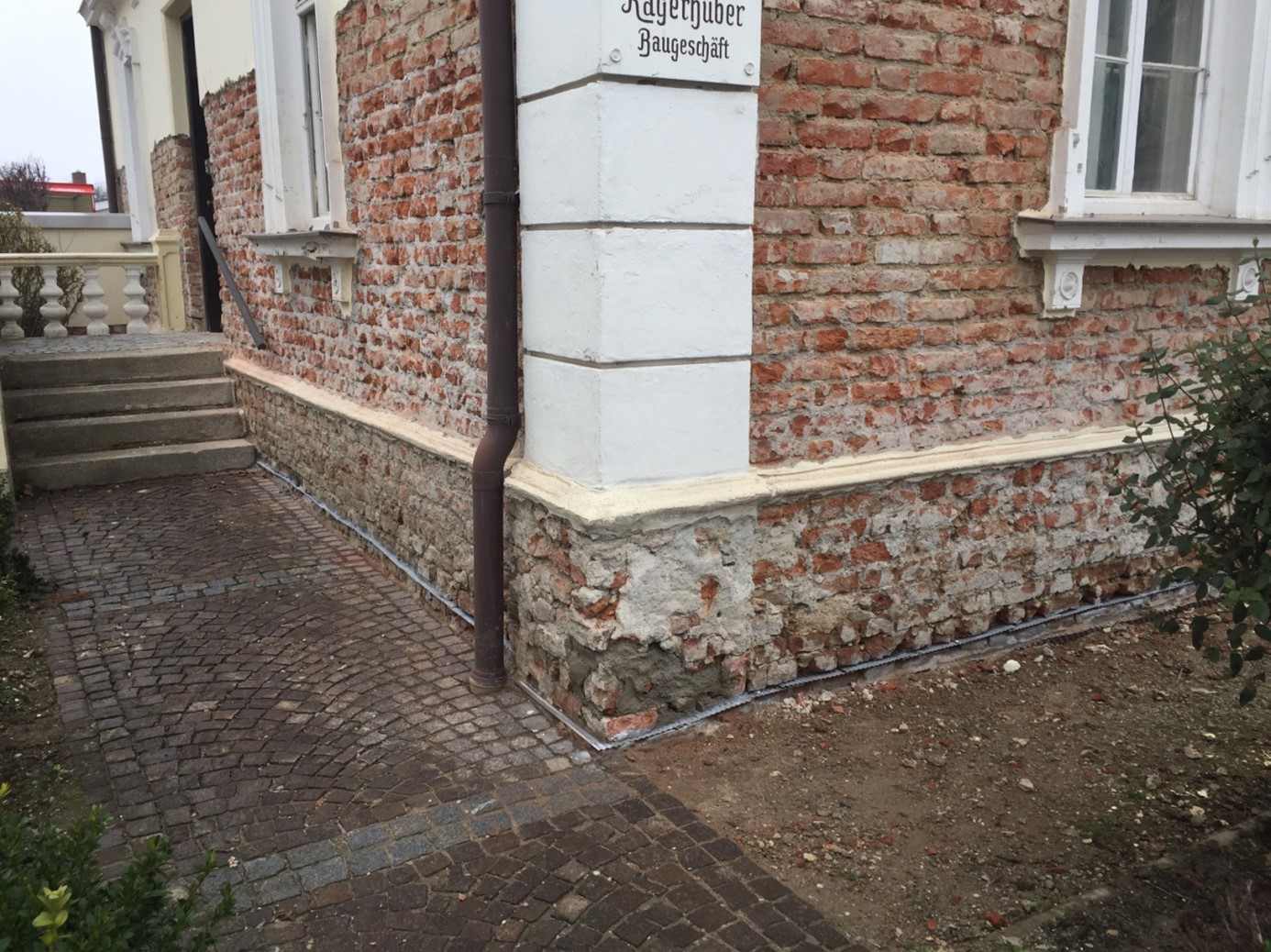
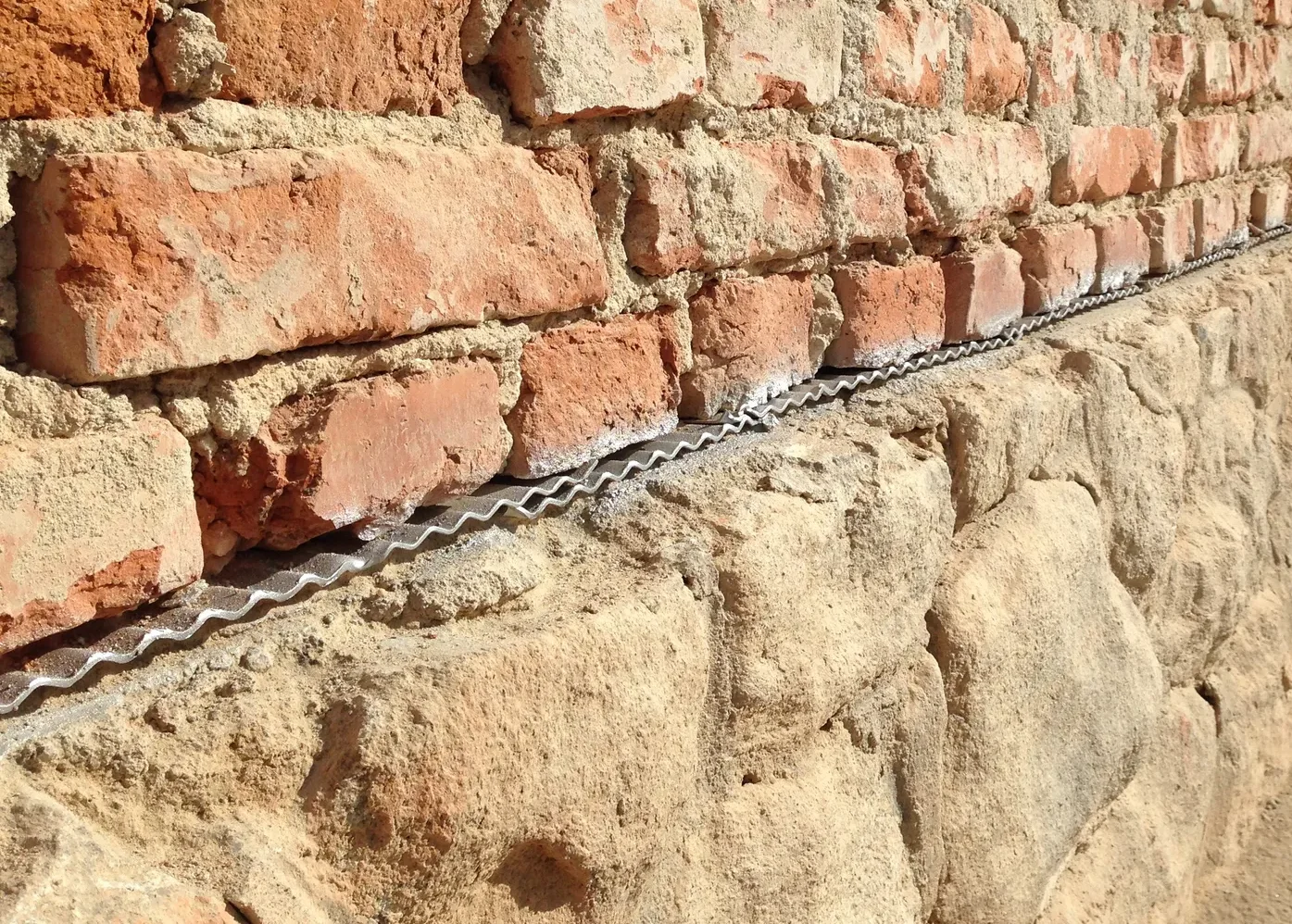
HW Mauertrockenlegung has developed the only single-step process to date for the mechanical drying of damp walls. In this process, patented, corrosion-resistant stainless steel plates are driven into the continuous horizontal bed joint of the masonry using specially designed impact tools.
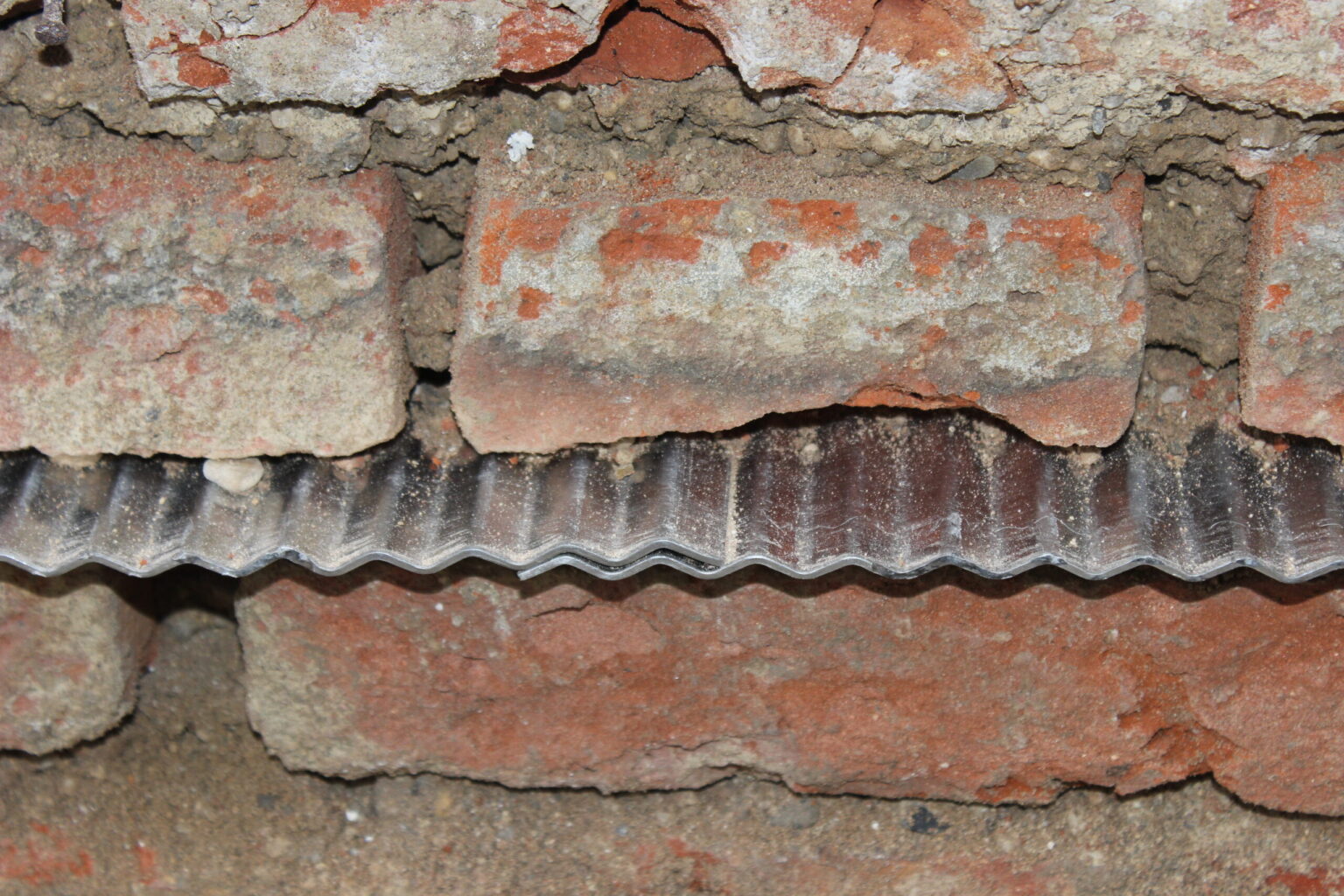
The panels overlap each other to form a continuous barrier layer—this prevents soil moisture and moisture in the masonry from rising by capillary action. A borehole grid for injecting chemical agents is not required.
Unlike methods in which the masonry is first opened or cut through, the force flow within the masonry is fully preserved during the installation of the HW stainless steel barrier, since no joint material is removed and the masonry cross-section is not interrupted at any point. As a result, the existing structural integrity remains uncompromised, and the risk of settlement—which can result from an interrupted masonry cross-section—is avoided.
The HW stainless steel barrier thus provides a technical solution to combat capillary moisture rise and lays an important foundation for the further renovation of damp areas.
When is a stainless steel barrier appropriate?
A HW stainless steel barrier is suitable when moisture rises by capillary action from the ground and the masonry has a continuous horizontal bed joint. This is particularly common in older brick buildings, but mixed-material and stone masonry can also meet the technical requirements.
Our partner companies will inspect your property on-site and determine the cause of the damp walls. You will then receive an assessment of whether the HW method is suitable for you.
Advantages of the Patented HW Process
Tapered plates for gentle installation
The driving edge of the HW stainless steel plates is arrowhead-shaped. This reduces friction and driving resistance. Less impact energy is required, which reduces shock and vibration during installation. Even thicker masonry can be reliably worked with these specially designed plates.
Single-stage process
without chemicals
Unlike other methods of masonry dehumidification, our method is a single-step process. This means that separation and sealing are performed in a single step. Furthermore, the HW method does not require a grid of drill holes for the application of chemical agents. This results in a durable and environmentally friendly solution.
Over 50 years of experience with the HW stainless steel lock
HW Mauertrockenlegung developed the original HW stainless steel barrier and connects customers with qualified partner companies for installation. Please contact Contact and determine whether your masonry meets the requirements for mechanical wall drying using a horizontal barrier.
Frequently Asked Questions About the Stainless Steel Barrier
Does the wall need to be drilled for the stainless steel barrier?
Yes, but only to a limited extent. For installation, support rods are attached, which requires drilling. The stainless steel plates themselves, however, are mechanically driven into the existing expansion joint. A drilling pattern for the application of chemical grout is not required.
Is the HW stainless steel lock also suitable for older buildings?
Yes, especially in older brick buildings, a retrofitted horizontal water barrier may be necessary. A continuous horizontal bed joint is a prerequisite.
How durable is a stainless steel horizontal barrier?
Stainless steel is corrosion-resistant and durable. Once installed, the barrier requires no maintenance or replacement. It is a permanent solution for damp walls.
Who will perform the installation?
HW Mauertrockenlegung develops the process and the stainless steel panels. Installation is carried out by trained HW partner companies from Germany, Austria, Romania, Slovenia, or the Czech Republic. Contact us Contact us at Haböck & Weinzierl GmbH to find a suitable company in your region.